Wind Reading Basics: Speed, Direction, and Value Explained
Oct 9, 2026 · Joel
Why Wind Is the Variable That Decides Consistency
Once your fundamentals are solid, wind becomes the biggest reason you miss. Your rifle, ammo, and dope can be perfect, but misjudging the wind’s angle by even one clock position will put you off a steel target at distance. Angle errors cause more misses than speed errors.
The good news: reading wind is a skill, not a gift. It comes down to three questions you answer before every shot. How fast is the wind moving? Where is it coming from? How much of it is actually pushing the bullet? Get a solid answer to each, and your wind calls get a lot more consistent.
Step 1: Speed
Speed is the hardest part to judge, so use every indicator the range gives you. Start with a wind meter at the line to calibrate your eye, then read what’s happening downrange.
Mirage is one of the best tools for reading speed at distance. Focus your scope just short of the target to see it. Mirage that boils straight up means little or no crosswind. Mirage that leans or flows sideways shows the wind’s direction, and the flatter it runs, the faster the wind. Above roughly 10–12 mph, mirage often disappears entirely, so switch to vegetation and terrain.
Want to go deeper on wind calling? Join the Precision Rifle Network Masterclass on Skool to learn how to judge wind speed from vegetation, terrain, mirage, and other cues downrange.
Step 2: Direction
Wind direction tells you which way to hold. A wind coming from your left pushes the bullet right, so you hold or dial left, into the wind. A wind from the right means you hold right.
Describe direction using a clock face, with your target at 12 o’clock and you in the center. A wind blowing from directly left is a 9 o’clock wind. A wind from directly right is a 3 o’clock wind. A wind in your face is 12 o’clock, and one at your back is 6 o’clock.
Check direction across the whole flight path, not just at your position. Wind at the firing line and wind halfway to the target are often different, especially in valleys, along tree lines, or near berms.
Step 3: Value
Wind value is how much of the wind actually pushes the bullet sideways. A full value crosswind pushes the bullet off course the most. A wind blowing straight toward or away from the target barely moves the bullet left or right.
Use the same clock face to assign a value:
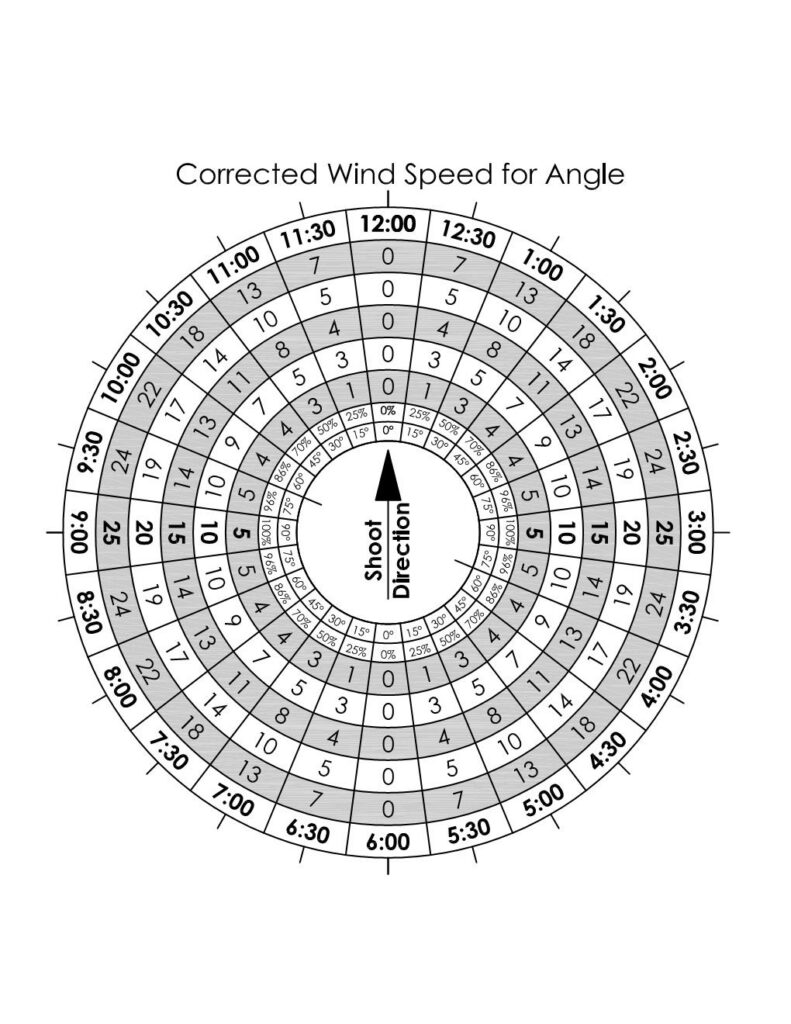
A no-value wind still matters. It rarely blows perfectly straight, and a slight shift toward 1 or 11 o’clock turns it into a half-value wind. When you see a 12 or 6 o’clock wind, watch closely for the switch.
Putting It Together: Build Your Call From a 10 mph Hold
The simplest way to turn speed, direction, and value into a hold is to know your 10 mph full-value hold at each distance you shoot. Pull it from your ballistic solver or your data book, then scale it.
Here’s an example, using a 10 mph full-value hold of 1.0 mil at 600 yards:
-
- Speed: Flags and mirage say about 5 mph, half of 10 mph.
-
- Direction: Wind is coming from 8 o’clock, so you’ll hold left.
-
- Value: 8 o’clock is in the half-value zone, with a 0.866 multiplier.
-
- Call: 5 mph is half your 10 mph hold, so 0.5 mil. Multiply by 0.866 to get 0.43 mil. Hold about 0.4 mil left.
If that same 5 mph wind shifts to 7 o’clock, the multiplier drops to 0.500. Your hold becomes 0.5 × 0.500 = 0.25 mil, about 0.3 mil left.
After the shot, compare your impact to your call. If you’re consistently off in one direction, adjust your speed estimate on the next shot, not your fundamentals.
Reading Wind Under Pressure
In PRS and NRL22, you don’t get unlimited time to study the wind. Use these habits to make good calls fast:
-
- Make your call during stage prep. Watch the wind while other shooters are on the clock, and write your hold on your arm board or wrist card before you step up.
-
- Watch other shooters’ impacts. Misses and hits from the shooters ahead of you are free wind data. Note where they hit and what direction they missed.
-
- Commit to a hold for the stage. Changing your call on every shot under time pressure usually causes more misses. Adjust only if you see a clear wind shift or a confirmed miss.
-
- Respect rimfire drift in NRL22. A .22 LR bullet is slow and light, so even a gentle breeze moves it a lot at 100 yards and beyond. Small targets make good wind reading even more important than in centerfire.
Start Practicing
Wind reading improves with repetition. Every time you shoot, make a call before the shot, record it, and compare it to your impact. Over a season, that log becomes your best wind teacher.
Ready to take your wind calling further? Join the Precision Rifle Network Masterclass on Skool for in-depth training on reading wind speed, direction, and value in real conditions.