
Let me know if you think this is a problem. You bought a case of good factory ammo. You read the velocity on the box and typed it into your ballistics app. Then you built your drop data off of it. Here’s the issue, though. That factory ammo velocity number didn’t come from your rifle.
By Joel, Precision Rifle Network
And at least one of the biggest ammo makers in the country says so on its own website. Today I’m covering what the box number actually is, what the marketing says, and the two camps on this. Then I’ll walk you through exactly what I do every time I open a new lot of ammo.

Where Factory Ammo Velocity on the Box Comes From
We’re going to start with the fine print. I’ll give Hornady credit here, because they answer this one straight. Their site has a frequently asked question on exactly this. It asks why velocity differs from what’s listed on the ammo box.
Here’s their answer. They publish the data from SAAMI spec test barrels. In their words, most rifle test barrels are 24 inches long. Then there’s the important line. Because of variables in individual chambers and barrels, velocities “may be faster or slower than those published.”
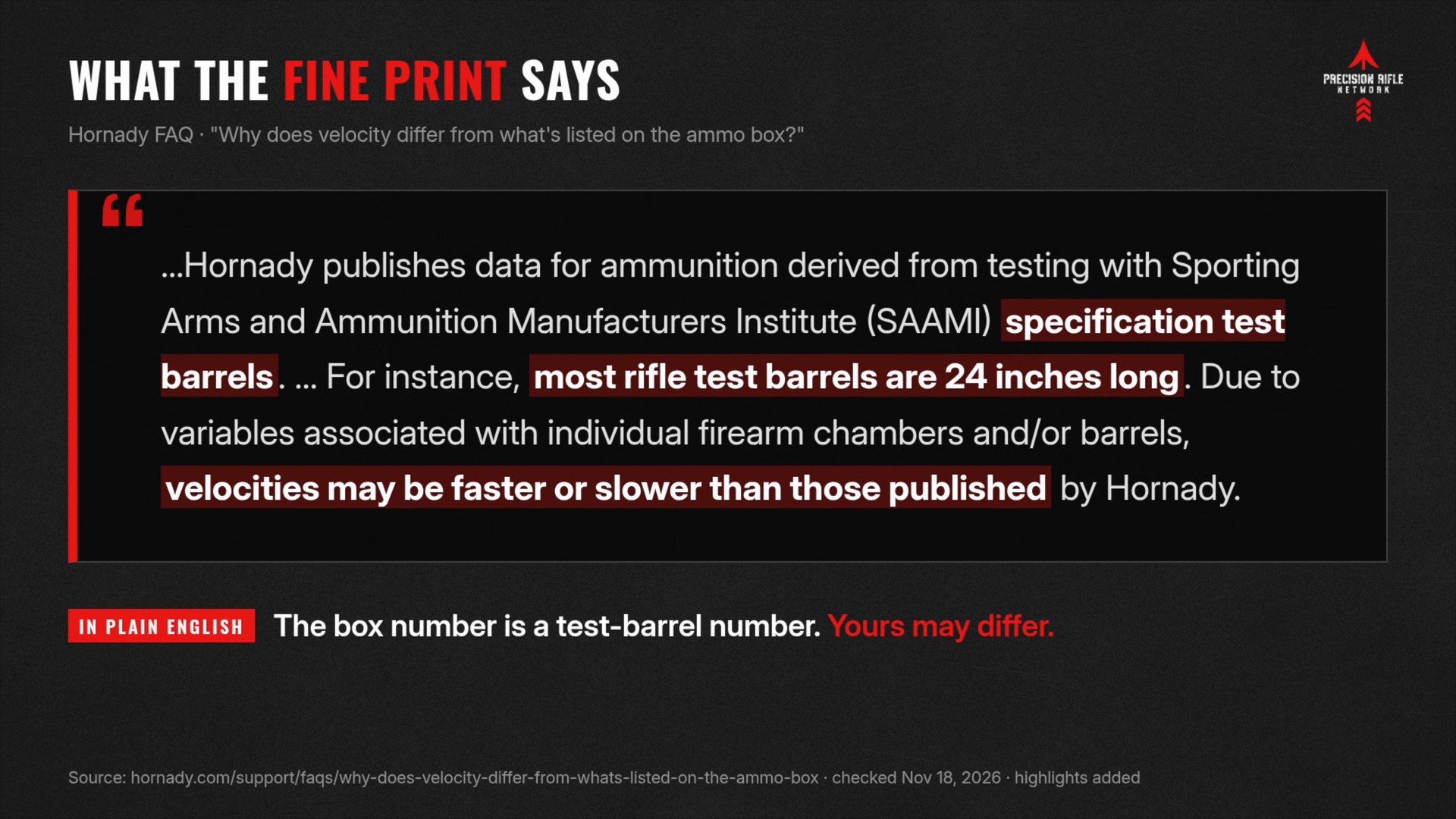
In other words, the box number is a test-barrel number. It came out of a barrel built to a spec.
Your Rifle Isn’t a Test Barrel
Your rifle has its own barrel length, its own chamber, and its own bore. Different barrel, different factory ammo velocity. Maybe it’s off a little, or maybe it’s off a little more. Either way, you don’t really know until you measure it.
My rifle isn’t a test barrel, and neither is yours.
The Fine Print vs. the Marketing
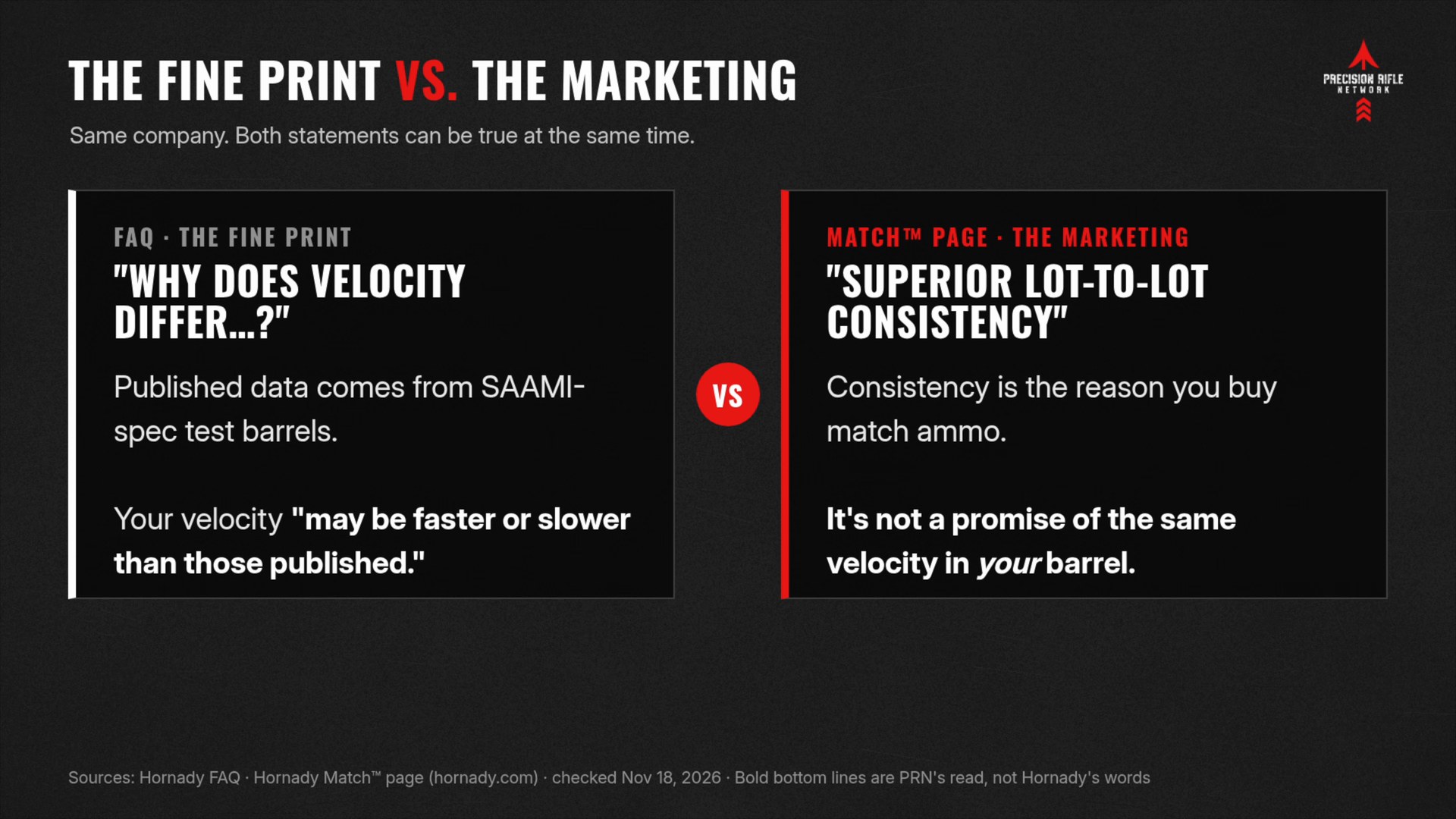
Here’s the other side, though. On Hornady’s ammunition page, they advertise, and I’m quoting, “superior lot-to-lot consistency.”
I am not saying that’s a lie. In fact, I’ve had great results with Hornady in the past. After all, consistency is the whole reason you pay for match ammo.
But put those two side by side. One says every lot is consistent. The other says your rifle may be faster or slower than the number. Both can actually be true at the same time.
What a Lot Number Actually Means
Here’s what a lot is. Factory ammo is built in batches, and each batch gets a lot number. Lot-to-lot consistency means the maker keeps those batches close to each other.
It doesn’t mean your new case runs the exact same velocity in your barrel as the last one did. Also, nobody prints that promise on the box.
This isn’t a Hornady thing, either. I’m only using their page because they explained it clearly. Every ammo company prints a number from its own testing. The box is just a starting point, and the chronograph out in the field is the true measurement.
The Two Camps at the Range
When this comes up at the range, people land in one of two camps:
- Camp one: the box number is close enough. You bought good ammo, and the target’s only a couple hundred yards out. Confirm zero and go shoot it.
- Camp two: chronograph everything. Every rifle, every lot, every time. The box is a guess, and you don’t build your drop data on a guess.
And honestly, camp one kind of has a point. Up close, a small velocity miss might not move your impact all that much.
Where I Land
Camp one is right that a small difference might not matter up close. But you don’t know it’s a small miss until you measure it, do you?
A factory ammo velocity error doesn’t stay small, either. The farther you shoot, the more it shows up in your drop.
You saw this if you watched my recent 6.5 PRC ammo test. Same rifle, same day, two different factory loads, and my rifle clearly preferred one of them over the other. First, I chronographed it. Then I trued up my data with my Kestrel before I trusted it on steel.
That video was about picking the right load. This one is about what happens when you buy the next case. I’m closer to camp two here, but I’m not obsessive about it. I just need to know whether the new lot matches the old one in my particular rifle.
What I Do With Every New Lot of Ammo
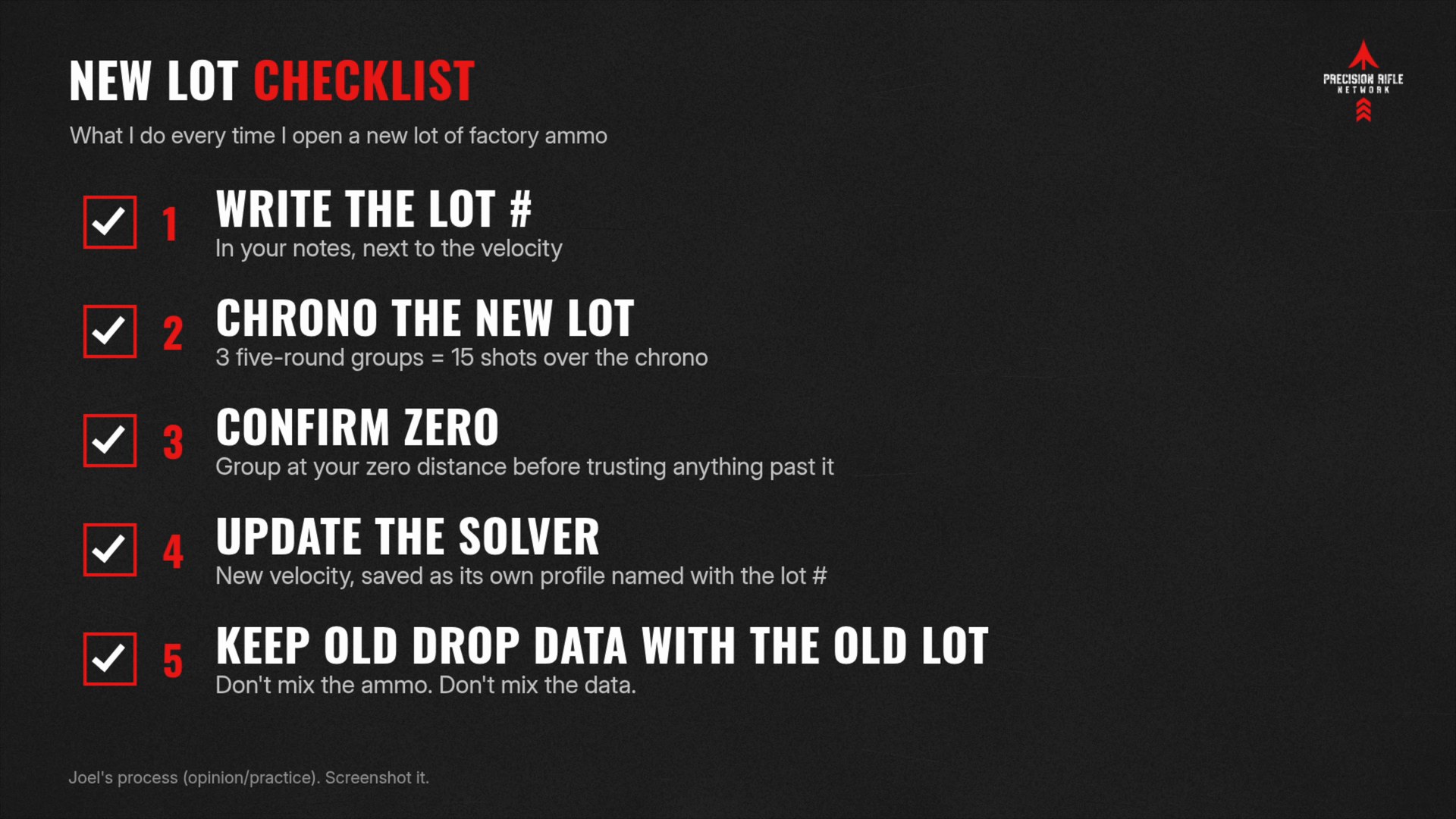
Here’s exactly what I do with a new lot of ammo:
- I write the lot number down. It’s printed on the box. It goes in my notes, right next to the velocity for that particular lot of ammo.
- I chronograph the new lot in my rifle. I fire three five-round groups, so that’s 15 shots total over the chronograph. That gives me an average I can actually trust. For the record, I use and recommend the Garmin, in case you’re wondering.
- I confirm zero. Even with the same ammo, a new lot can land in a slightly different spot. Shoot a group at your zero distance before you trust anything past it. Here’s how I confirm my rifle zero if you want the full walkthrough.
- I update the solver. The new velocity goes in the app as its own profile, with the lot number in the name. That way I’m not overwriting old data.
- I keep the old drop data with the old lot. If I’ve still got boxes of the old stuff left, that data stays with those boxes. In short, I don’t mix ammo, and I don’t mix the data.
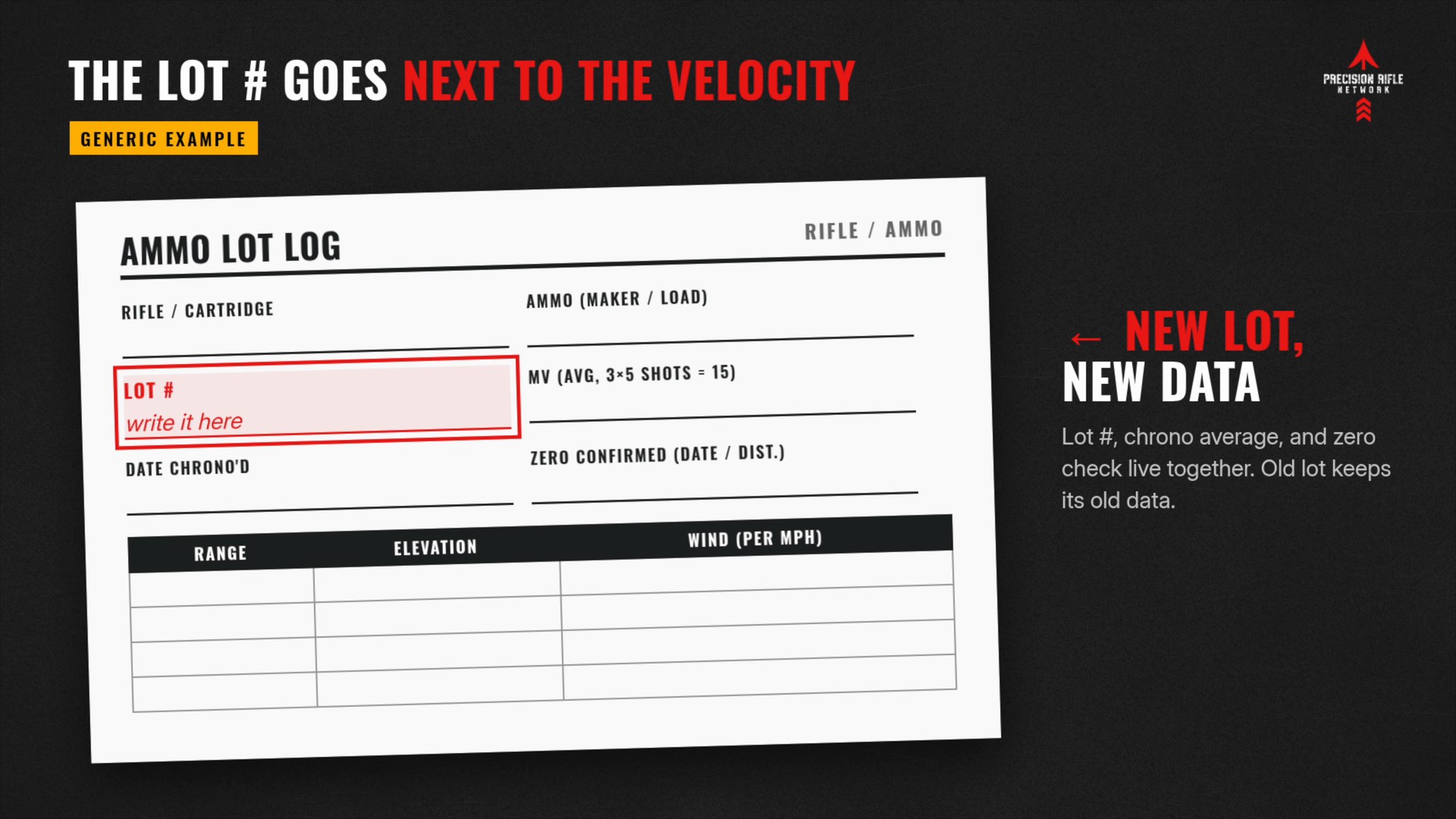
Takeaway: a new lot is new data until it proves it’s the same as the old one. That goes for factory ammo velocity on every box you buy. Sometimes it is the same. That’s a good day, because now you know. And knowing is half the battle.
One Safety Note on Pressure Signs
Someone always asks about this one. If you ever see pressure signs with your factory ammo, stop shooting it. Then maybe consider emailing the manufacturer about it. I just want you to be as safe as possible.
Key Takeaways
- The box number is a test-barrel number. For example, Hornady says its data comes from SAAMI spec test barrels, most of them 24 inches long.
- Your rifle may be faster or slower. Your barrel length, chamber, and bore all change the number.
- Lot-to-lot consistency is real, but it isn’t a promise that your next case runs the same velocity in your barrel.
- A velocity error grows with distance. Close enough at 200 yards can turn into a miss farther out.
- Treat every new lot as new data. Measure the factory ammo velocity yourself. Log the lot, chrono 15 shots, and confirm zero. Then save a new solver profile and keep the old data with the old boxes.
How Much Did Your Last Lot Change?
When was the last time you switched to a new lot of the same factory ammo? Did your velocity change? Do you remember? Did you write it down, or did it hardly change at all? Or did you have to redo your drop data because you switched?
Tell me the cartridge and the barrel length in the comments. I really want to hear from you guys. I’m trying to get an idea of how many people see consistent changes across certain manufacturers and ammo types.
Still Struggling with Wind?
Here’s the last thing. Obviously, wind is still out there. Even if you get your velocity right for your ammunition, you might not know how to call the wind correctly. As a result, that can lead to misses, and it has nothing to do with your barrel or your ammo.
That’s why I’d love for you to check out the Wind Mastery System. The full course is one of our online masterclasses in the Precision Rifle Network Skool community. Plus, you get the Wind Mastery System e-book free when you sign up. I’d love to have you there. If you want a starting point first, check out my wind reading basics.
Also, check out our Etsy store and the shop on our website for digital downloads. We’ve got targets, tall target tracking tests, scope cant error tests, data books, and all kinds of other stuff.
Sponsor note: As you know, I’ve been working with Cole-Tac forever and a day. Code PRN10 still gets you 10% off anything Cole-Tac sells. With it being almost hunting season, check out the small ammo wallet. It holds 10 rounds of your favorite hunting ammo.
Thanks for reading, guys!